
The Practical Guide to Acoustic Baffles
What baffles are · Types · Placement · Specs · Mistakes
What is an acoustic baffle?
An acoustic baffle is an absorptive element mounted so sound can reach more than one face. Many baffles hang vertically from ceilings; others are suspended horizontally as clouds. Their open mounting can expose more absorptive surface than a panel attached directly to a wall.
Baffles are primarily a room-treatment tool. They reduce reflected sound and reverberation inside a space. They are not a substitute for a properly designed wall, ceiling, door, or glazing assembly when the goal is to prevent sound from traveling to another room.
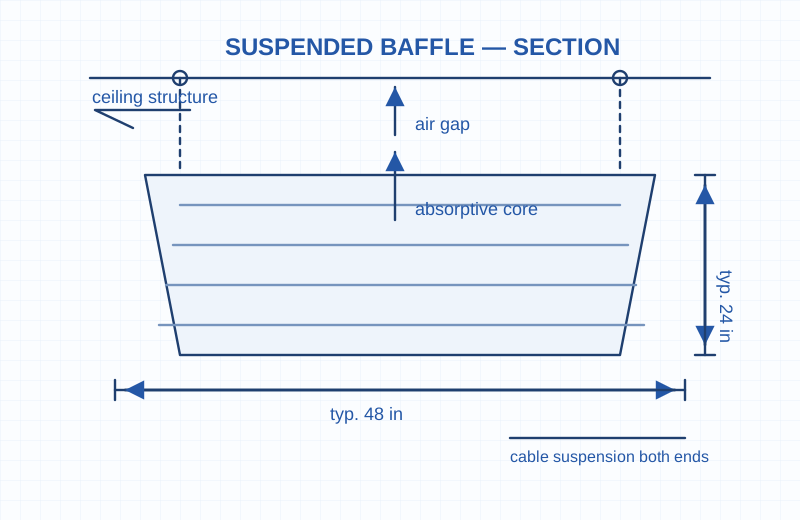
Common baffle and treatment types
| Type | Best for | Watch for |
|---|---|---|
| Porous absorptive baffle | Speech clarity, reverberation, general mid/high-frequency control | Thickness and fire rating matter |
| Ceiling cloud | First reflections, open offices, studios, classrooms | Suspension hardware and ceiling load |
| Diffuser | Scattering strong reflections while retaining energy | Needs distance and adequate depth to work as intended |
| Bass trap | Low-frequency decay and modal problems | Usually needs significantly more depth |
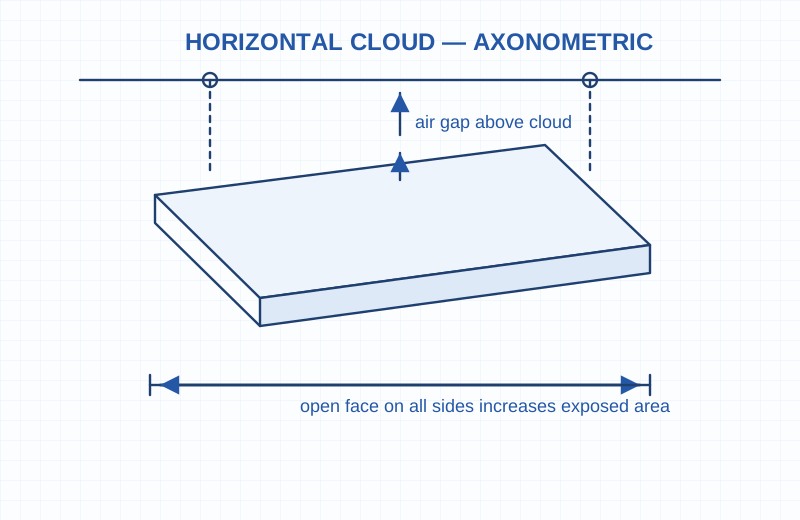
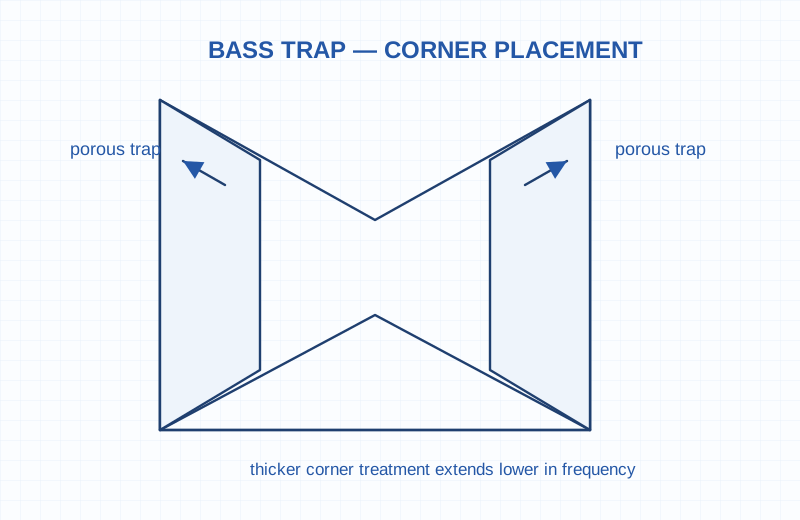
Placement principles
Place absorption where it intercepts important reflection paths or where large untreated hard surfaces create excessive reverberation. In recording and listening rooms, first-reflection points are often a priority. In gyms, restaurants, offices, and halls, total absorptive area and distribution across large surfaces can matter more than a few precisely placed small panels.
Leaving an air gap behind a porous absorber can improve performance lower in frequency because particle velocity is higher away from a rigid boundary. The useful gap depends on absorber depth and target range; “more gap is always better” is not a universal rule because space and mounting constraints matter.
Specs worth comparing
Look beyond marketing labels. Useful product documentation can include absorption coefficients by octave or one-third-octave band, NRC or equivalent summary ratings, fire-test classifications, thickness, density, mounting method, weight, dimensions, edge construction, cleanability, and environmental conditions.
NRC is a convenient average, but it does not tell the whole story. Two products with similar NRC values can behave differently at low frequencies. For studios and critical rooms, frequency-by-frequency absorption data is more informative.
Five common mistakes
- Buying absorptive foam to solve sound transmission through a wall.
- Choosing panels only by color or NRC without checking frequency data.
- Using too little material for the room volume and reverberation problem.
- Ignoring doors, ducts, gaps, ceilings, and other flanking paths when isolation is the goal.
- Over-treating high frequencies while leaving low-frequency decay uncontrolled.
How much treatment do you need?
There is no universal “X panels per 100 square feet” answer because room volume, existing finishes, occupancy, target use, panel dimensions, mounting, and frequency range all matter. A furnished living room may need modest treatment; a hard-surfaced gym or cafeteria may require a much larger absorptive area. For commercial projects, target reverberation time and applicable building or accessibility requirements should guide design.
Frequently asked questions
Do ceiling baffles soundproof a room?
No. Their main job is to absorb reflections inside the room. They can lower the room's reverberant sound level, but transmission through walls, doors, windows and structure requires isolation measures.
Are thicker baffles better?
Thickness generally helps porous absorbers work lower in frequency, but material flow resistance, mounting, air gap and total surface area also matter. Compare tested absorption data instead of thickness alone.
Should baffles be vertical or horizontal?
Both can work. Vertical baffles expose two broad faces and suit high ceilings; horizontal clouds can target ceiling reflections and create a clean visual plane. Room geometry and suspension constraints decide which is more practical.
Can I cover every surface with absorption?
You can, but that may create an unnaturally dry high-frequency response while leaving bass problems. Most rooms benefit from balanced, measured treatment rather than maximum coverage.