
Room Acoustics Guide: Diagnose Before You Buy
If voices blur together, start with absorption. If bass changes dramatically from seat to seat, investigate room modes and placement. If sound is heard in another room, investigate isolation and flanking paths.
1. Separate room sound from sound transmission
Room acoustics describes what happens to sound after it is produced inside a room: reflections, decay, resonances, clarity, and spatial impression. Sound isolation describes how much sound passes through or around a building boundary. The two interact, but the fixes are different.
2. For echo and speech clarity
Hard parallel surfaces can create flutter echo; large reflective rooms can produce long reverberation that masks consonants and makes conversation tiring. Add broadband absorption at effective surfaces, especially ceilings and upper walls where it remains out of the way. Spread treatment rather than clustering everything in one corner.
3. For a studio or home theater
Start with geometry and placement: center the listening position sensibly, avoid sitting exactly against a wall when possible, and experiment with speaker distance from boundaries. Then treat first reflections, add meaningful bass trapping, and measure again. Diffusion can be useful once decay and low-frequency problems are under control and the room has enough distance for the diffuser to work.
4. For an office, restaurant, or classroom
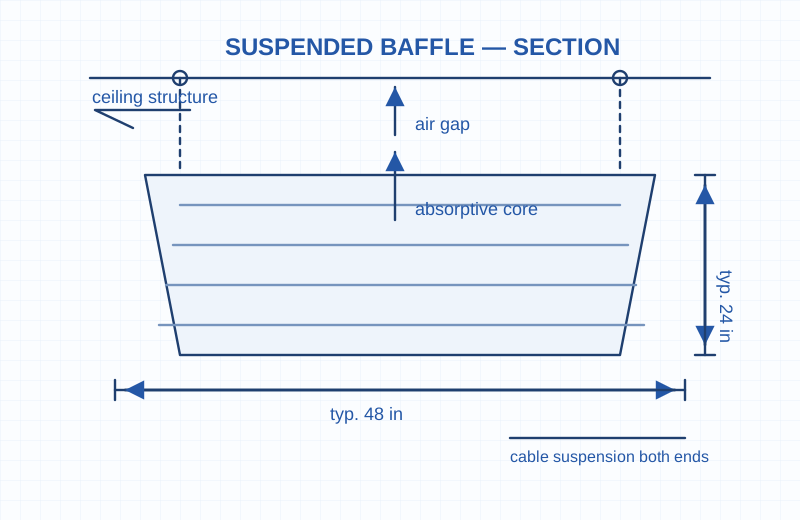
The goal is often intelligibility and comfort rather than “dead” acoustics. Ceiling baffles or clouds can add a large amount of absorption without occupying wall space. Soft finishes and upholstered furniture help, but they do not always supply enough broadband absorption for a busy, hard-surfaced room.
5. For sound getting through walls
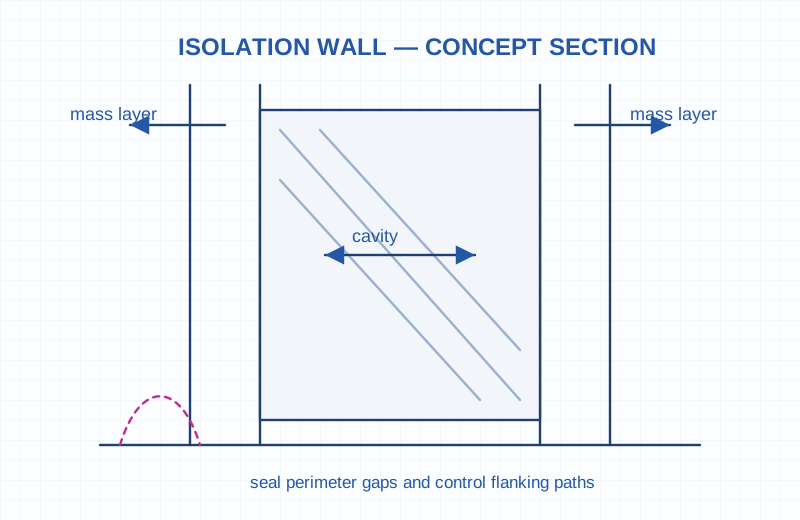
Check obvious leakage first: door undercuts, unsealed electrical boxes, penetrations, return-air paths, and lightweight doors. Effective isolation typically combines airtightness with mass, damping, cavity absorption, and/or structural decoupling. Adding a decorative absorber to one side of a wall may make the source room quieter, but the wall assembly still determines much of the transmission performance.
A simple treatment sequence
- Define the complaint in plain language.
- Identify the frequency range and whether the problem is reflection or transmission.
- Measure room dimensions and note hard/soft surfaces.
- Fix speaker/listener position before buying large quantities of treatment.
- Add the highest-impact treatment first.
- Listen and measure again before the next purchase.
When to call a professional
Use an acoustical consultant or qualified designer when privacy, code compliance, environmental noise, vibration, performance venues, multi-family separation, critical listening, or expensive construction is involved. A short consulting engagement can cost less than rebuilding an assembly chosen by guesswork.
See the difference: treatment vs isolation
Frequently asked room-acoustics questions
Why does my room echo even with carpet?
Carpet mainly affects higher frequencies and only covers one surface. Large bare walls, ceilings, glass and long room dimensions can still create strong reflections and long decay.
Why does bass disappear in one seat and boom in another?
Low-frequency standing-wave patterns create peaks and nulls. Moving the listener or speakers can change the response dramatically, which is why placement should be tested before buying treatment.
Will acoustic foam stop my neighbors hearing music?
Usually not in a meaningful way. Foam absorbs reflections inside the source room but adds little mass and does not seal leakage paths. Isolation is a building-assembly problem.
What should I treat first in a small studio?
Start with speaker/listener placement, then control strong early reflections and low-frequency decay. Measure after each major change so you do not over-treat one range while ignoring another.